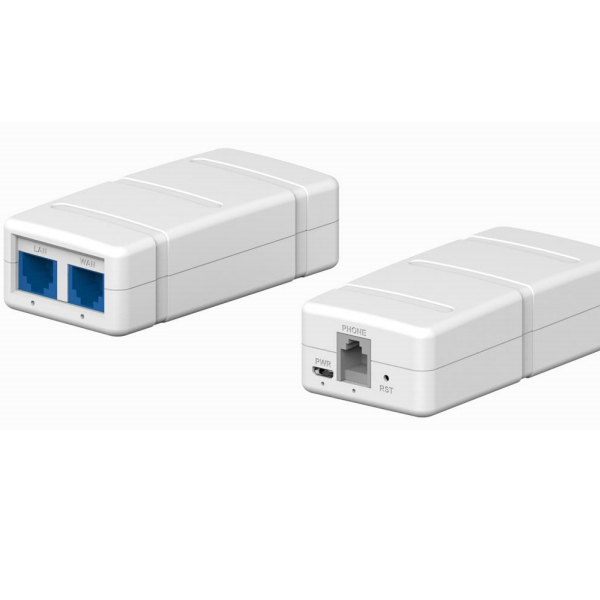
If you have a perfectly good analog telephone and want to use it with a modern VoIP phone system — without running a single Ethernet cable to it — the WiFi VoIP Gateway (WG6001) from VIN Telecom is built for exactly that. It converts your standard analog phone into a full SIP VoIP phone over your Wi-Fi network, with one FXS port, two 10/100 Mbps Ethernet ports, and enterprise-grade call features in a palm-sized unit.
In this guide, we explain what a WiFi VoIP gateway is, how the WG6001 works, its hardware and software specifications, and where it makes sense to deploy one around the world.
What Is a WiFi VoIP Gateway?
A VoIP gateway converts traditional telephony signals into SIP-based IP packets — and vice versa (The Telecom Spot, “VoIP Gateways”). When the gateway includes an FXS port and built-in wireless connectivity, it becomes a WiFi VoIP adapter: plug an analog phone into the RJ11 “PHONE” port, connect the device to your Wi-Fi network, and the phone instantly registers with your SIP server or IP-PBX as if it were a native IP phone.
The result: your existing phones keep working, but now they sit on the VoIP network — with lower call costs, unified extension dialing, and no rewiring.
Why Choose a WiFi VoIP Gateway?
The “WiFi” in the name is the whole point. Unlike a traditional wired analog telephone adapter (ATA), the WG6001 connects over the air:
- No cable runs — place phones anywhere within Wi-Fi range, not just next to a router
- Rentals & temporary sites — offices, hotel rooms, and pop-up locations get phone service in minutes
- Keep existing phones — no need to replace analog handsets or retrain staff
- Easy management — remote provisioning and monitoring over the network
WiFi VoIP Gateway (WG6001): Key Features
- 1× FXS phone port (RJ11) — connect one standard analog telephone
- Built-in Wi-Fi (IEEE 802.11b/g/n @ 2.4 GHz) — cable-free VoIP registration with WPA-PSK/WPA2-PSK security, AES/TKIP encryption, hidden SSID support, and up to 10 connected users
- 2× 10/100 Mbps RJ45 Ethernet ports (WAN + LAN) — wired setups for maximum reliability
- 3-way voice conference — instant multi-party calls from an analog phone
- Auto provisioning — bulk deployment and centralized device management for volume rollouts
- SIP V1.0/V2.0 with primary + backup SIP server — automatic failover for business-critical lines
- Wide codec support: G.711a, G.711u, G.723, G.726, G.729
- Fax support: VBD, T.30, T.38 — send and receive faxes over VoIP reliably
- Full DTMF: in-band, SIP Info, and RFC2833
- Rich calling features: call forwarding (busy / no answer / unconditional), call waiting, caller ID, speed dial, 3-way calling, call transfer, call hold, music on hold, do-not-disturb, hotline, anonymous call rejection, and more
- Advanced DSP: VAD, CNG, echo cancellation, adjustable input/output gain, ring frequency and voltage settings
- Professional management: WEB, CLI, SNMP, and TR-069 for standard provisioning platforms
- Secure connectivity: PPTP / L2TP VPN and VLAN (802.1Q) support
WG6001 Hardware Specifications
Software & Protocols
Where to Deploy the WG6001 Around the World
Because it needs only Wi-Fi and a power socket, the WiFi VoIP Gateway fits almost any scenario:
- Home offices & remote workers — a desk phone on the VoIP PBX without cabling
- Small & medium businesses — add an extra extension anywhere an Ethernet drop doesn’t exist
- Hotels & serviced apartments — quick in-room analog phone service over the property’s Wi-Fi
- Retail, clinics & branch offices — instant second line or fax line at low cost
- Emergency / temporary locations — standing up phone service in minutes
In every case, the payoff is the same: existing analog phones, zero cabling, full VoIP features — and a path to cut traditional phone line costs.
WiFi VoIP Gateway FAQ
Q1. What is a WiFi VoIP gateway? A device that connects a standard analog telephone to a VoIP network over Wi-Fi. It converts the phone’s analog signals into SIP/IP calls, so the phone works with IP-PBX systems and VoIP providers.
Q2. How many phones can the WG6001 support? The WG6001 has 1 FXS (RJ11) port, supporting one analog phone. Larger deployments simply use one gateway per phone, or upgrade to a multi-port VoIP gateway.
Q3. Does it work with my existing VoIP provider or IP-PBX? Yes. The WG6001 is SIP-based (SIP V1.0/V2.0) with configurable SIP server, realm, and account settings, and supports standard codecs (G.711, G.729) plus fax (T.38) — compatible with mainstream platforms.
Q4. Can it connect without Wi-Fi? Yes — it also has two 10/100 Mbps Ethernet ports (WAN + LAN), so it can be used fully wired when Wi-Fi is not available or preferred.
Q5. What call features does it support? Call forwarding, call waiting, caller ID, 3-way calling, call transfer, call hold with music, DND, hotline, speed dial, anonymous call rejection, and more.
Q6. How is it managed and configured? Through a web interface (WEB), command line (CLI), SNMP, or TR-069 — including remote provisioning and firmware management for large deployments.
Ready to Put Your Analog Phones on VoIP?
The WiFi VoIP Gateway (WG6001) is the fastest, lowest-cost way to modernize: one FXS port, built-in Wi-Fi, SIP with automatic server failover, and a feature set that matches far bigger gateways. It’s manufactured by VIN Telecom (Shenzhen Vintelecom Technology Co., Ltd.), a telecom terminal equipment manufacturer founded in 2009 with R&D, production, and global export experience.
Contact our team for a quote, OEM/ODM options, or help selecting the right gateway for your deployment.