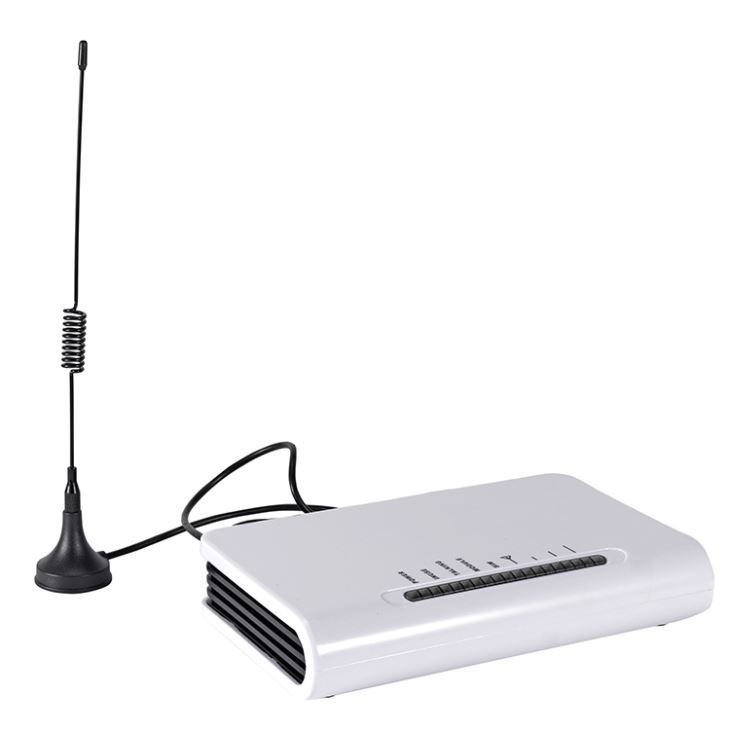
If you need a reliable telephone in a place where there are no phone lines — a mountain village, a ship, a remote office — the GSM Fixed Wireless Terminal (FWT) from VIN Telecom is the answer. It’s a compact, 1-SIM base terminal that connects your regular analog phone to the GSM mobile network: insert a SIM card, plug in any telephone, and it works like a landline — but the “line” is cellular.
In this guide, we explain what a fixed wireless terminal is, why it’s still essential worldwide, its key functions, and its complete technical specifications.
What Is a GSM Fixed Wireless Terminal (FWT)?
A fixed wireless terminal (FWT), also called a fixed cellular terminal (FCT), is a device that bridges an ordinary analog telephone and a mobile network. The terminal holds a SIM card and connects to GSM via its built-in antenna; your phone plugs into the terminal just as it would into a wall jack. Calls are placed and received over the mobile network — with the terminal acting as the “base station” for the handset.
Because it works with the quad-band GSM frequencies 850 / 900 / 1800 / 1900 MHz, the same terminal operates across most of the world, from Europe and the Middle East to the Americas and Asia.
Why Choose a Fixed Wireless Terminal?
The FWT solves one simple problem: telephone service where there is no wired infrastructure. That makes it the go-to solution for:
- Remote countryside & mountain areas — phone service without laying cable
- Homes and offices with weak fixed-line signals — reliable calling via the stronger cellular network
- Public telephone shops & telemarketing centers — low-cost lines with simple operation
- Offices & small businesses — an instant second line without waiting for a carrier installation
- Moving locations — ships, trains, and long-distance buses where a fixed line is impossible
It’s easy to install, easy to operate, has powerful signal reception, clear voice quality, a long working life, and steady performance — the key characteristics that make it a trusted choice in over 100 countries.
Key Functions of the FWT
- Clear status display — multi-function LED/LCD indicators show signal strength and running state at a glance
- All call types supported — dial local, mobile, international, and special free calls
- Built-in watchdog circuit — if the terminal ever malfunctions, it restarts automatically for continuous service
- DTMF support — works with standard communication voltage, so automated services (IVR, phone banking, intercoms) function correctly
- Caller ID with time & date — see who called, and when
- Automatic card-locking & net-locking — optionally lock the device to a specific SIM card or network for fleet/deployment control
- Modem mode — supports data connections through the cellular network for fax or dial-up applications
FWT Technical Specifications
Where the FWT Is Used Around the World
The official application list matches real-world deployments exactly:
- Remote country & mountain regions — primary phone service where no fixed line exists
- Dwellings with weak signals — a home phone that rides the stronger cellular network
- Public telephone shops — payphone-style service operated with a standard handset
- Offices & telemarketing — low-cost, instantly available phone lines
- Ships, trains & long-distance buses — phone service that moves with you
In every case, the benefit is identical: a normal telephone, a normal dial tone, and a cellular network behind it — no landline, no installation wait, no infrastructure cost.
GSM FWT FAQ
Q1. What is a GSM fixed wireless terminal (FWT)? A device that connects a standard analog telephone to the GSM mobile network through one SIM card. The phone behaves like a landline, but all calls travel over cellular — ideal where fixed lines are unavailable.
Q2. Which GSM frequencies does it support? Quad-band: 850 / 900 / 1800 / 1900 MHz, so it operates in most regions worldwide with a compatible SIM.
Q3. What power does it need? DC 5V or DC 12V input, with a built-in battery: 48 hours standby and 2–6 hours of talk time, fully recharged in about 6 hours.
Q4. Can I use it with my existing telephone? Yes — it’s designed to work with any standard analog telephone or fax device through its handset interface.
Q5. What happens if the device has a fault? A built-in watchdog circuit detects faults and automatically restarts the terminal, minimizing downtime in critical locations.
Q6. Does it support caller ID and DTMF services? Yes — it displays caller ID with time and date and fully supports DTMF, so phone banking, IVR, and other automated services work normally.
Ready for Reliable Calling Anywhere?
The GSM Fixed Wireless Terminal (FWT) is the simplest, most cost-effective way to bring telephone service to places without lines: 1 SIM, quad-band GSM, 48-hour standby, caller ID, and a watchdog-protected design that keeps working where it’s needed most. It’s manufactured by VIN Telecom (Shenzhen Vintelecom Technology Co., Ltd.), a telecom terminal equipment manufacturer founded in 2009 with R&D, production, and global export experience.
Contact our team for a quote, volume pricing, or help selecting the right fixed wireless solution for your region.