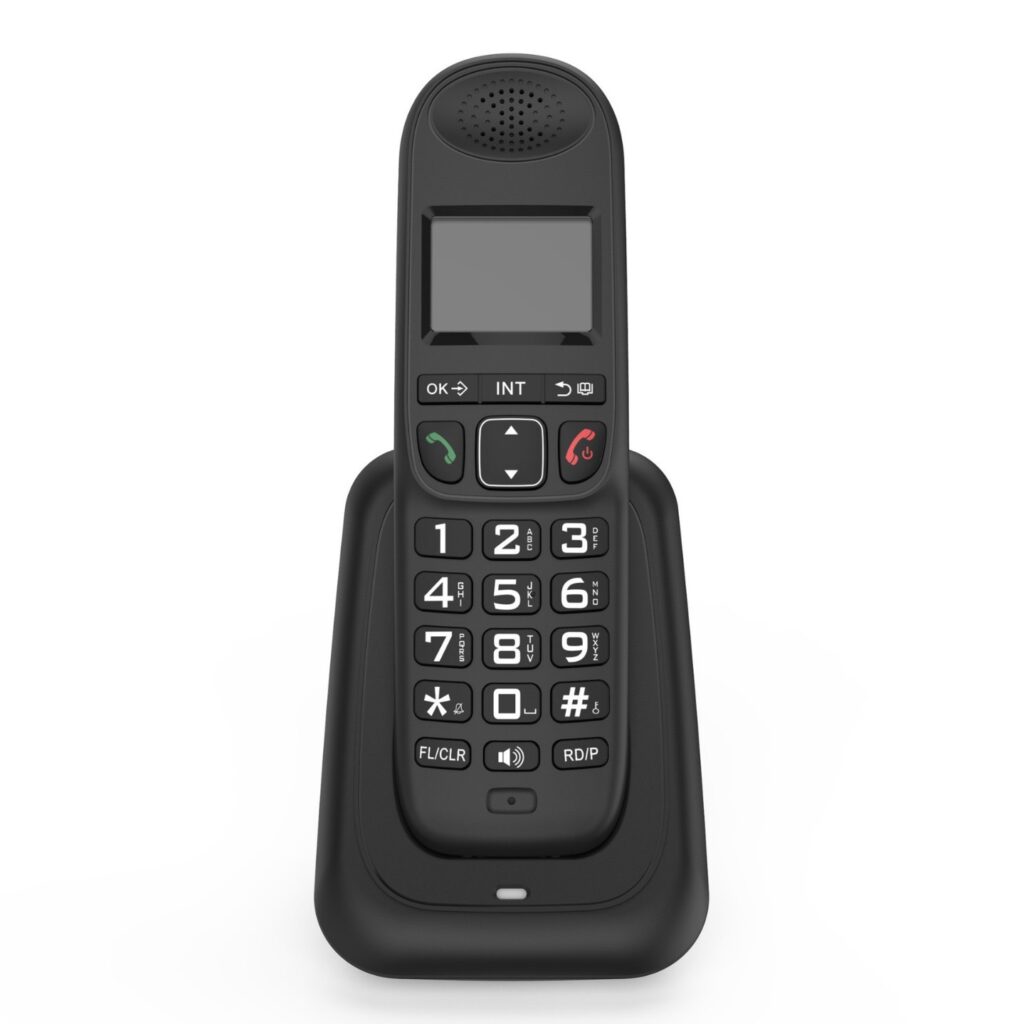
If your team is constantly walking between the front desk, the stock room and the workshop, a corded desk phone is the wrong tool. A DECT cordless telephone puts a reliable business handset in your pocket and lets up to five handsets share one base unit — so one line covers a whole floor without a single new cable run.
This guide explains what DECT cordless telephones are, what to check before buying, and how to connect a cordless base to a modern VoIP or PBX phone system.
What makes DECT different from a home cordless phone
DECT is a dedicated digital cordless standard designed for voice. Unlike Wi-Fi handsets that compete with laptops and access points, DECT operates on its own regulated radio band with its own channel management — so business handsets sound consistent and keep working when Wi-Fi is busy.
Practically, that means three things for a business:
- Predictable audio — the handset is not sharing airtime with data traffic.
- Multi-handset systems — a base can register several handsets, each working as its own extension-like device with its own conversations.
- Battery behaviour you can plan around — a charging cradle at the desk, a handset that rings wherever the person is.
What this DECT system offers
This expandable DECT cordless telephone is built for desktop business use, and the feature list is aimed at teams, not single users:
- Up to 5 handsets on one base unit — and each handset can register to up to 4 bases, so a handset can roam between floors or buildings that each have their own base
- 3-line LCD display with backlight for caller and menu information
- Intercom and handset-to-handset call transfer — put a call through to a colleague without involving the PBX operator
- 3-way conference between an external caller and two handsets
- 50-entry phone book (12 characters, 20 digits per entry), plus 30 incoming and 10 outgoing number memories
- 16 interface languages: English, Spanish, French, German, Italian, Portuguese, Dutch, Polish, Danish, Norwegian, Swedish, Hungarian, Greek, Turkish, Russian and Ukrainian
- 10 selectable ringtones, adjustable earpiece, hands-free and ringing volume, with different melodies for different callers
- Dialling barring and keypad lock — control which numbers can be dialled from mobile handsets
- Redial, pause, pre-dial and edit, tone/pulse dialling, flash time selection (100/300/600/1000 ms), auto/manual answer, mute, and alarm clock
- In-use and charging LED indicators
For a small team, one base can serve reception, sales and the back office at once, with intercom calls handled internally.
Where a multi-handset DECT system fits best
- Retail and showrooms — one handset at the till, another on the floor, neither losing the call when the customer moves.
- Warehouses and workshops — the office line follows the person who knows where the stock is.
- Clinics and service counters — staff can step away from the desk while remaining reachable for bookings and callbacks.
- Small hotels, guesthouses and serviced apartments — front-desk mobility for check-ins, housekeeping coordination and internal calls, without running cabling down corridors.
- Home offices and annex buildings — where pulling a new phone cable is expensive or simply not allowed.
Making the cordless base work with VoIP
This is the detail most buyers miss: the cordless base is an analog telephone device. It expects an analog line — the same kind of connection a wired desk phone uses. So how you integrate it depends on your phone system:
The practical consequence: cordless mobility is a layered upgrade. Add it today on the extension port you already have, and move the same hardware onto VoIP later with an FXS port in front of it.
Specifications at a glance
FAQ
Q1. How many handsets can one DECT base support? Up to five handsets can be registered to the same base unit, and each handset can register to up to four bases — useful when one person works across two locations.
Q2. Can handsets call each other internally? Yes. The system supports intercom calls between two handsets, call transfer to another handset, and a three-way conference joining an external call with two handsets.
Q3. Does the cordless telephone work with an IP-PBX? It works on any analog line or extension. With an IP-PBX you place an FXS gateway port in front of the base, which converts the analog connection into a SIP extension — the handsets then work exactly like any other extension.
Q4. Can I stop staff from dialling premium numbers? Yes. The handset includes a dialling barring function, and a keypad lock for handsets that stay in public areas.
Q5. Do I need new wiring to add handsets? No. Extra handsets register to the existing base over the air; only the base itself needs a telephone connection, plus a power point for each handset’s charging cradle.
Q6. Is this the right choice for a large call centre? Not for a call centre seat count — those seats are better served by IP phones with headset ports. DECT cordless is designed for mobile roles: reception, floor staff, warehouse and service teams, and small hotels.
The bottom line
A DECT cordless telephone solves the two costs of desk phones — cabling and immobility — with a single base unit and up to five handsets. It is the cheapest way to give a small team reachable, professional handsets, and it integrates cleanly with both traditional PBX extension ports and modern IP telephony through an FXS gateway.
VIN Telecom supplies the expandable DECT cordless telephone alongside the PABX systems and FXS gateways that connect it, so the mobility layer and the phone system come from one supplier with one set of firmware and support.