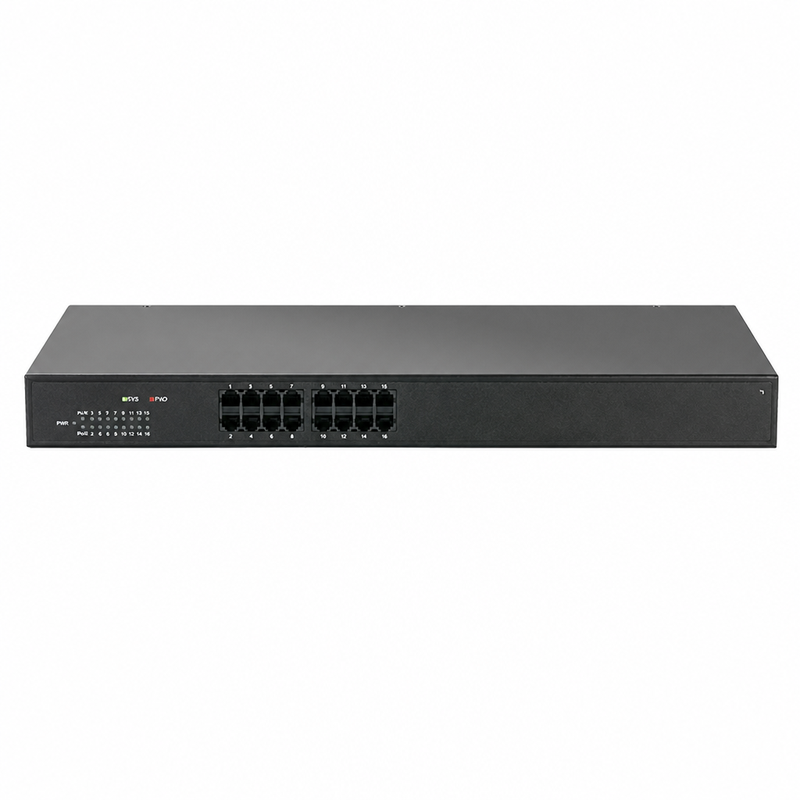
Most businesses have two phone worlds: traditional telephone lines from the local carrier, and a modern IP telephony network that saves money and adds features. The FXO-16O — 16 Ports FXO Analog VoIP Media Gateway from VIN Telecom is the bridge that joins them. It takes up to 16 standard analog PSTN lines and makes them all available to your IP-PBX, softswitch, or hosted VoIP platform over SIP.
In this guide, we explain what an FXO gateway is, how the FXO-16O works, and why businesses use it to cut telecom costs without giving up existing numbers.
What Is an FXO VoIP Gateway?
FXO (Foreign eXchange Office) is the interface a device uses to connect to a telephone company’s analog line — the same kind of jack a fax machine plugs into. An FXO VoIP gateway houses many such ports and converts the calls arriving on them into IP calls. So while an FXS gateway turns analog phones into VoIP extensions, an FXO gateway turns analog phone lines (trunks) into VoIP trunks.
The FXO-16O carries 16 FXO ports and 16 SIP channels. Each FXO port connects to one analog PSTN line from your carrier, and the gateway registers those lines with a SIP server. Your legacy copper lines and their numbers then operate as normal trunks on your IP phone system.
Why Offices & SMBs Choose the FXO-16O
- Keep your existing phone numbers — connect carrier lines and route them through your IP-PBX; no porting headaches
- A natural migration path — move gradually: IP calls go over SIP while FXO lines remain as overflow/failover trunks
- Cost control — the gateway also supports call budgeting by amount, minutes, or call count, and denied-number lists
- Open-standard SIP, 16 channels — registers to multiple SIP proxies with primary and secondary SIP accounts for automatic failover
- Better voice quality — G.711/G.729/G.726/iLBC/AMR codecs, G.168 echo cancellation, VAD, adaptive jitter buffer
- Easy administration — web, SNMP/TR-069, auto-provisioning, cloud management
- 1U rack-mount — 440 × 202 × 44 mm, ~2.7 kg, at home in any server room
Key Features for Business Deployments
- Analog trunks over IP — 16 FXO ports (RJ-11; RJ-21 on some models) convert PSTN lines into SIP trunks
- Failover-ready — primary/secondary SIP accounts, IP load balancing, and IP fault tolerance keep calls flowing if one path fails
- Flexible routing — 32 inbound/outbound rules, port groups, IP trunks, number manipulation, and digit maps
- Call handling — call waiting, blind/attended transfer, call forward (busy/no reply/unconditional), hold, pickup, hotline, DND
- Voicemail & conferencing — voicemail plus 3-way and multi-way conferencing across TDM and IP calls
- Fax over IP — T.38 FoIP with T.30 (V.17) transcoding and pass-through up to 14.4 kbps for office fax machines
- Smart call analysis — Call Progress Analysis detects voice, answering machines, DTMF, and fax tones for correct routing
- Billing & audit — call budgeting plus detailed CDR records for review and cost allocation
- Security — TLS/SRTP encryption, OpenVPN, built-in firewall, and access rules
- Full network support — IPv4/IPv6, QoS, VLAN separation for voice/data/management, NAT (route and bridge), static routing
FXO-16O Core Specifications
How Offices & SMBs Use a 16-Port FXO Gateway
- Keep your numbers during migration — run SIP trunks and legacy PSTN lines side by side
- Cost-effective backup trunks — if a SIP trunk or internet link fails, calls route out over the FXO lines
- Multiple locations, one system — connect local analog lines at each branch to a central IP-PBX for unified routing and CDR
- Call centers & hotlines — carrier lines terminate on FXO ports with CPA routing, budgeting, and denied-number lists
- Fax continuity — keep existing fax lines working over the IP network with T.38 support
The outcome for any business: the reliability of your existing phone lines and the cost savings of IP telephony — in one 1U gateway.
FXO VoIP Gateway FAQ
Q1. What is a 16-port FXO VoIP gateway? A gateway with 16 FXO ports connecting up to 16 analog PSTN lines to a SIP/IP network (IP-PBX, softswitch, or hosted VoIP), with 16 SIP channels.
Q2. What’s the difference between FXO and FXS? FXS ports provide analog lines to phones; FXO ports connect to analog lines from the carrier. An FXO gateway brings your existing PSTN trunks onto the IP network.
Q3. Can I keep my existing phone numbers? Yes — that’s the main use case. Your carrier lines plug into the FXO ports, so the numbers stay active while the gateway routes them through your IP phone system.
Q4. Which VoIP platforms does it work with? It uses open-standard SIP V2.0 and registers to multiple SIP proxy servers with primary/backup accounts, so it works with most IP-PBX and hosted VoIP platforms.
Q5. Does it support fax? Yes — T.38 FoIP with T.30 (V.17) transcoding and pass-through up to 14.4 kbps keeps existing fax machines working over IP.
Q6. How reliable is it for business operation? Primary/backup SIP accounts, IP load balancing and fault tolerance, a non-blocking design, and standard 100–240V AC power make it suitable for continuous operation.
Ready to Bring Your Phone Lines onto IP?
The FXO-16O keeps the analog PSTN lines you already pay for — and their numbers — fully working inside your IP phone system: 16 FXO ports, 16 SIP channels, failover routing, call budgeting, CDR, and T.38 fax in one 1U unit. It’s manufactured by VIN Telecom (Shenzhen Vintelecom Technology Co., Ltd.), a telecom terminal equipment manufacturer founded in 2009 with R&D, production, and global export experience.
Contact our team for a quote, volume pricing, or help planning your IP telephony deployment.