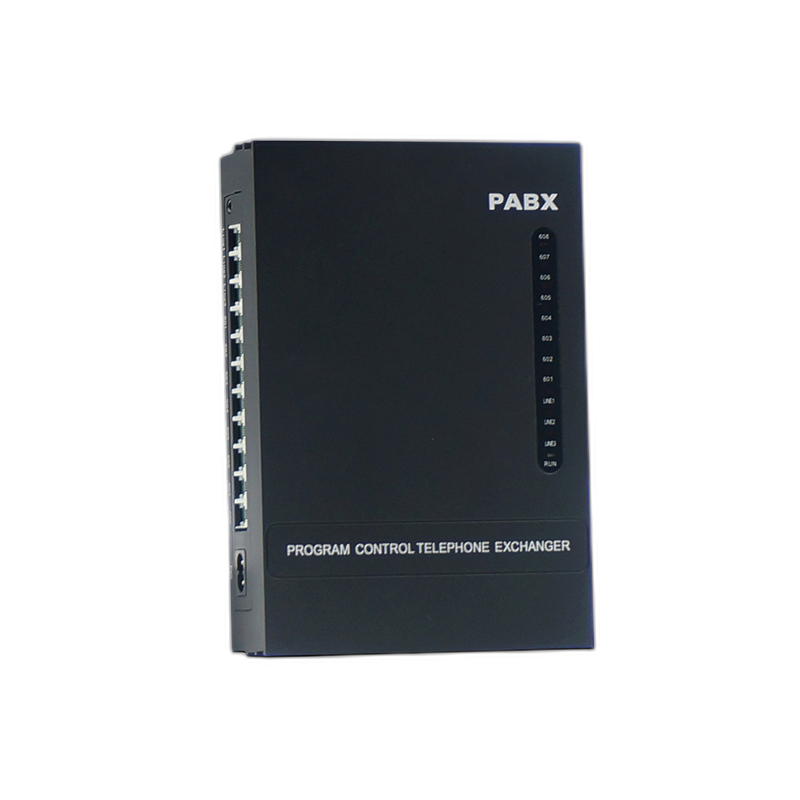
If you are comparing phone systems for a small office, hotel or retail business, you have probably met the two letters that dominate every search result: VoIP. Cloud providers would like you to believe the traditional analog PBX is obsolete. The reality is more practical: for thousands of small businesses, an analog PBX still delivers the most reliable phone service at the lowest lifetime cost. This guide compares analog PBX vs IP PBX honestly – covering cost, reliability, call quality, features and maintenance – so you can decide which system actually fits your business.
What Is an Analog PBX and How Does It Differ from an IP PBX?
A PBX (Private Branch Exchange) is a private telephone exchange that connects internal extensions to each other and to the outside telephone network. An analog PBX (often called PABX) connects standard analog telephones over twisted-pair wiring to public telephone lines (PSTN). An IP PBX routes calls over an IP data network and typically connects SIP phones, softphones and VoIP trunks.
For a plain-language comparison of the terminology, see our earlier article on the difference among PABX, PBX and IP-PABX.
When Does an Analog PBX Still Make Sense?
An analog PBX is not the right answer for every company – but it is the right answer for more businesses than the cloud providers admit. Choose analog when:
- Your phone lines are analog today. If your building is wired with standard telephone jacks and your carrier still supplies PSTN lines, an analog PBX connects directly – no new cabling, no network upgrade, no SIP configuration.
- Reliability is non-negotiable. A power failure can take down VoIP equipment. Many analog PABX systems include power failure transfer, which automatically switches calls to the PSTN line so your phones keep working in an outage.
- Call quality must be predictable. Analog voice quality does not depend on internet bandwidth, jitter or network congestion. What you hear is what the line delivers – every time.
- You want a low, one-time cost. Analog systems have no per-seat licence fees, no monthly service contract and no software subscriptions. You pay once for hardware that lasts for years.
- Your staff just need to make and receive calls. If you do not need video, team chat, CRM integrations or remote softphones, you should not pay for them.
When Should You Choose an IP PBX Instead?
Be honest with yourself: an IP PBX is the better choice when you need:
- Remote and hybrid work – staff taking calls from home on softphones.
- Integration with business software – CRM, helpdesk, unified communications.
- Many sites under one system – branch offices sharing one phone system.
- Advanced features – video calling, presence, mobility apps.
If your team lives in Microsoft 365 or similar platforms and communicates mostly over data networks, an IP solution such as our IP PBX product range is likely the right fit.
Analog PBX vs IP PBX: Honest Comparison
Case Example: The SV-308 for a Small Hotel or Office
A typical example of where analog still wins: a 10-20 room hotel or a small office with 3 external lines. The SV Series PABX connects 3 CO lines to 8 extensions with 7 simultaneous communication channels, and includes features many small businesses actually use every day:
- Power failure transfer – calls continue during an outage.
- Auto-attendant with recordable OGM – professional greeting without hiring a receptionist.
- Call transfer, forwarding, three-way conference and call pickup – standard office functions.
- Call restriction and call duration control – manage staff usage.
- Built-in lightning protection and memory protection – survive storms and blackouts without losing programming.
All for a one-time hardware cost – no monthly fee, no licence, no internet dependency.
How to Decide: A 60-Second Checklist
Answer these five questions:
- Do any of your employees need to take business calls remotely? (Yes = look at IP)
- Is your building already wired with standard telephone lines? (Yes = analog is cheaper to deploy)
- Can you tolerate the phone system going down when the internet or power fails? (No = analog wins)
- Do you need video calls or CRM integration on the phone system itself? (Yes = look at IP)
- Do you want a fixed one-time cost with no subscription? (Yes = analog wins)
Three or more analog answers? A traditional system like the SV Series is very likely the better investment.
Still Not Sure? Ask a Manufacturer, Not a Cloud Provider
Most comparison articles online are written by VoIP providers who only sell one answer. A manufacturer that builds both analog and IP systems has no reason to push you in the wrong direction. We have been designing and manufacturing telephone systems since 2009, export to more than 80 countries, and build both analog PABX and IP PBX product lines.
Tell us about your premises, your lines and your staff – we will recommend the system that fits, even if it is not ours. Email sales@vintelecom.net or use the contact form for a free consultation and quote.